Aromatic Investigation
Do Essential Oils Really Repel Ants? What Science Actually Shows
Reviewed by Quentin Olagne, certified aromatherapist (NAHA) • June 1, 2026
Mint, lavender, eucalyptus… the same oils keep coming up again and again. But what does science actually say?
What everyone recommends is not necessarily what actually works.
Every summer, the same advice circulates online.
• Sprinkle peppermint oil around doorways
• Place lavender sachets near windows
• Diffuse eucalyptus oil indoors
• Add lemon essential oil to a spray bottle
But one problem appears repeatedly: these recommendations are almost always repeated without scientific references.
So I decided to look at what the research actually shows.
Which oils actually work? And which ones are based mostly on tradition?
The answer is more nuanced, and more interesting, than most content suggests.
Why Ants Are Hard to Control
Ants function as a distributed system based on pheromone trails. Each individual continuously reinforces the chemical pathways used by the colony.
This mechanism enables extremely fast, highly scalable coordination: a single chemical trace can organize thousands of individuals within minutes.
In this context, removing ants one by one is often ineffective at colony scale.
The most relevant strategies therefore target communication itself: trail disruption, disorientation, or inhibition of recruitment (failure to attract and mobilize other ants).
What Scientists Measure
This classification isn't just an academic exercise: it's what lets you choose the right blend for your situation further down this page.
In scientific research, essential oils are never studied as “ant solutions” in the popular sense. They are only evaluated through their observable effects on colony behavior.
In other words: science does not think in terms of oils, but in measurable behavioral responses.
These responses fall into three broad families. We'll give them short labels (M1, M2…) later in this article, but here's what they actually mean:
Behavioral system
Ants modify orientation, communication, and foraging activity.
Physiological response
Some molecules induce measurable neurophysiological stress, generally dose-dependent.
Environmental stability
Real-world effectiveness depends on compound persistence under field conditions (evaporation, heat, surface).
These categories serve two purposes further down this page: reading the compound-by-compound evidence table, and choosing the right blend for your situation in the two situations further down: a few ants spotted, or an already-established colony. The practical reading of observed effects uses these same three families to summarize, compound by compound, what's solid and what isn't.
How these mechanisms translate into active compounds
The observed effects in ants do not depend on essential oils as whole extracts, but on the aromatic molecules they contain.
When comparing active compounds, distinct behavioral profiles emerge based on how they interact with ant sensory systems.
Summary of key studied compounds and their impact on core behavioral responses:
Reading grid used below: M1–M5
M1 avoidance
M2 trail disruption
M3 foraging suppression
M4 physiological stress
M5 persistence
A reading grid, not a scoring scale: the table below states only what each study actually measured.
| Compound | Tested on | Observed result |
|---|---|---|
Carvacrol → oregano oil, savory oil, some thyme oils | Fire ants: lab test (will workers refuse to dig in treated sand?) | Repellent. Most repellent compound tested: minimum effective dose 0.98–7.8 µg/g, outperforming DEET in the same assay. ref. [1] Insects |
Thymol → thymol-chemotype thyme oil | Fire ants: same test (digging in treated sand) | Repellent. Clearly repellent but 4–32× weaker than carvacrol depending on species (effective dose 7.8–31.25 µg/g). ref. [1] Insects |
Linalool-chemotype thyme (same plant, no thymol/carvacrol) → linalool-chemotype thyme oil | Fire ants: same test, the counter-example | No effect. No repellent effect measured, even at the highest tested dose (125 µg/g). ref. [1] Insects |
Eugénol → clove bud oil | Fire ants: field test, over 24h | Long-lasting repellent. The only one of 5 tested compounds to stop ants from covering the treated surface with soil to bypass it: effect held >24h, comparable to DEET. ref. [3] Pest Management Science |
Eucalyptol, camphor, menthol, methyl salicylate → eucalyptus, rosemary CT camphor, peppermint, wintergreen | Fire ants: same test, over 24h | Short-term repellent. Repellent for ~1h, then bypassed: ants cover the treated surface with soil particles and walk on top. >90% of the compound had evaporated by 24h. ref. [3] Pest Management Science |
| The compounds above showed only repellent effects. From here on, the following studies measure actual toxicity: contact or fumigant mortality, not just avoidance. | ||
Camphre → camphor tree oil, rosemary CT camphor | Fire ants: fumigant exposure in a sealed chamber | Toxic (fumigant). Measurable toxicity from vapor alone: lethal dose 1.67–4.28 µg/mL, up to 84.9% mortality at 72h. ref. [4] J Insect Science |
Camphor, carvone, citral → rosemary CT camphor, spearmint, citronella/lemongrass | Destroyer ant: direct contact on treated filter paper | Toxic (contact). Real, dose-dependent contact toxicity: 78–90% mortality at 12h at the higher doses; citral is the most toxic of the three. ref. [5] Discover Applied Sciences |
Citronella (citral/citronellal) → Java/Ceylon citronella oil | Argentine ant & fire ant: barrier choice test + continuous exposure | Repellent + toxic. Both repellent and toxic to both species: 100% mortality (Argentine ant) and 50.6% (fire ant) after 24h continuous exposure. ref. [2] J Entomol Science |
Peppermint / tea tree → peppermint, tea tree (Melaleuca alternifolia) | Argentine ant & fire ant: same test | Repellent. Repellent to both species; toxic to the Argentine ant (85–90% mortality) but not to the fire ant. ref. [2] J Entomol Science |
Eucalyptus (whole oil) → Eucalyptus globulus | Argentine ant & fire ant: same test | No effect. No repellent or toxic effect measured at any tested rate: the only compound in the set that failed entirely in this study. ref. [2] J Entomol Science |
Tea tree (by concentration) → Tea tree (Melaleuca alternifolia) | Leaf-cutting ants: lab then field | Dose-dependent. No effect below 0.1%. Clearly repellent only at 1–10%, effect lost after ~3–4 days. ref. [6] Int J Pest Management |
D-limonène → citrus oils: lemon, sweet orange, grapefruit | Leaf-cutting ants: choice between treated and untreated bait | Repellent. Dose-dependent repellent, no mortality observed; its effect can be masked by a highly attractive substrate (citrus pulp). ref. [8] Bulletin of Insectology |
This table doesn't measure every compound on the same scale: each row reflects the ant species and exact protocol of the cited study. That's deliberate. No composite score is invented here, only what each study actually measured. Full references are at the bottom of the page.
Two situations, two blends
The table above answers "does it work?". In practice, the right answer depends on where you are. Two very different situations bring two kinds of people to search "essential oil ants":
Situation 1
A handful of stray ants in the kitchen, no visible colony. You just want to send the message: not welcome here.
→ the M1 mechanism (avoidance) is usually enough: the lightest approach, and also the least durable.
Situation 2
An active, regular trail, going on for several days. The colony already knows the way: simple entry repellency won't be enough.
→ this needs M2 (erase the trail) combined with M5 (hold over time), the most realistic approach, but it takes two steps.
The three blends below map to these situations. The entry spray covers situation 1. The trail wipe and the perimeter barrier, used together, cover situation 2.
Ant Control Protocol: 3 Functional Aromatic Systems
This system is not based on “repelling smells” in the traditional sense. It is based on three behavioral mechanisms observed in ant colonies: M1 (entry avoidance), M2 (trail disruption), and M5 (environmental persistence).
Important distinction: the M1/M2/M5 mechanisms and the choice of active molecules (thymol, carvacrol, eugenol…) come directly from the studies cited above. The exact formulations below (dosages, ethanol base, ratios) are my own formulation practice, not a published result. None of the cited studies tested this exact blend.
Why vodka (ethanol) is used as the base
In this protocol, ethanol is not included for traditional reasons, but for its physicochemical role as a solubilizer of aromatic compounds.
- Improves dispersion of essential oils in water (reduces phase separation)
- Enhances volatility of active terpenes (stronger olfactory field)
- Supports more consistent M1 / M2 behavioral disruption
- Evaporates cleanly, leaving minimal residue compared to acidic systems
Unlike vinegar, ethanol is not acting as a repellent signal itself, but as a delivery system for controlled aromatic diffusion.
With that rationale in place, here are the three concrete formulations that follow from it.
1. Entry Spray (Stop ant entry)
For situation 1: a handful of stray ants
Function: create a sensory discontinuity zone to reduce entry attempts and disrupt local environmental recognition.
- Mechanisms
- M1 strong • M2 moderate • M5 short
- Base (100 ml)
- water + 15–20 ml vodka
- Essential oils
- 18–25 drops
- Peppermint (Mentha × piperita) → strong M1 activation (sensory avoidance)
- Citronella (citral / citronellal) → M2 pheromone trail disruption
- Tea tree, Melaleuca alternifolia (≥1% of the blend) → M1 activation, but only above this threshold: below 0.1%, no effect was measured.
- No eucalyptus here: eucalyptus globulus is, as of now, the only compound in the evidence table above with no measurable effect on ants. We're not recommending it just because it's the most common online advice.
- Trace of thymol → reinforces overall behavioral disorganization
2. Trail Wipe (Erase navigation)
For situation 2: established colony, step 1 of 2
Function: disrupt and degrade existing pheromone trails to reduce navigation continuity and limit recruitment.
- Mechanisms
- M2 dominant • M3 moderate • M5 moderate
- Base (100 ml)
- 25 ml vodka + water
- Essential oils
- 20–30 drops
- Thymol → primary trail disruption agent (strong M2, direct chemical signal interference)
- Carvacrol → amplifies trail destabilization and reduces recruitment efficiency
- Limonene (lemon) → olfactory masking and mild interference with trail recognition
- Eugenol (trace) → prolonged behavioral modulation (M3/M5), not a primary trail degradation agent
This system does not chemically remove pheromones in a strict sense, but disrupts their readability and temporal stabilization.
3. Perimeter Barrier (Long-term effect)
For situation 2: established colony, step 2 of 2
Function: create a persistent olfactory zone that gradually reduces re-entry probability and stabilizes behavioral disruption over time.
- Mechanisms
- M5 dominant • M1 moderate • M2 mild
- Base
- lipid-based carrier or oil application (long-acting surface film)
- Essential oils
- 10–18 drops
- Eugenol → contributes to reduced foraging activity and moderate residual effect
- Thymol → maintains background behavioral pressure (weak but continuous M1/M2)
- Menthol (trace) → occasional reinforcement of initial avoidance
This approach does not aim for immediate action, but for a gradual shift in re-entry probability.
Recap: what, where, and which mechanism
The system doesn't rely on a single effect, but on three mechanisms applied to three different zones.
Entry spray
Where: thresholds, door frames, window sills, cracks.
Trail wipe
Where: visible active trails, counters, baseboards, corners, walls.
Perimeter barrier
Where: exterior baseboards, foundation perimeter, window ledges.
Reading it: 1 blocks entry right away but fades fast, 2 erases what's already established, 3 holds over time but acts slowly. That's why situation 2 (established colony) combines 2 and 3 instead of relying on a single product.
Field Validation (Outdoor Observation)
In field conditions, this disruption appears immediately but remains temporary if the source is not removed.
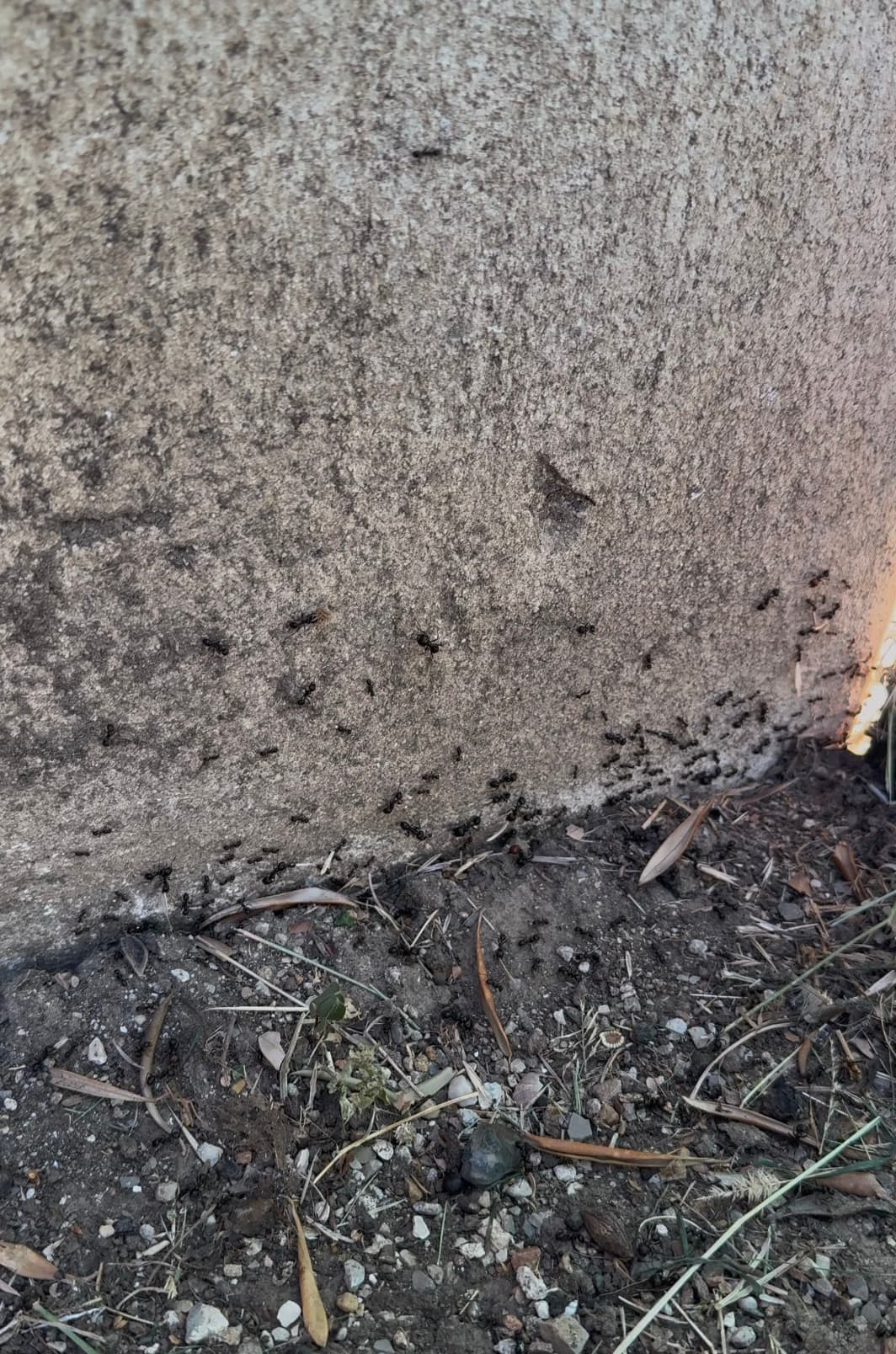
Before spray application
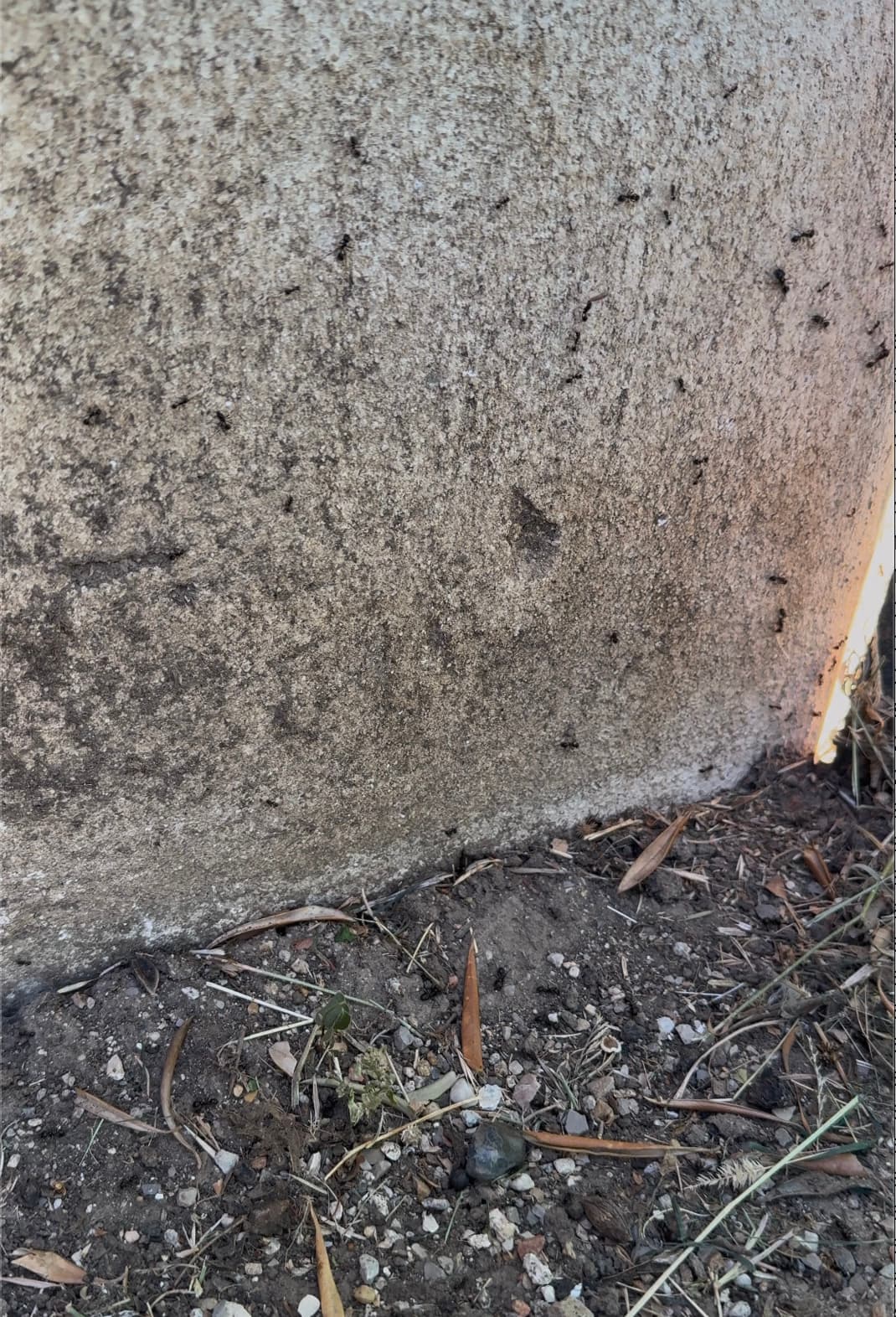
~30 seconds after application
Before / after spray application on an active pheromone trail. Ants lose coordinated movement and disperse locally within ~30 seconds. This is a field observation illustrating the trail-disruption mechanism described in the literature (not a controlled long-term efficacy test).
Field Observation
The evidence table above comes from published literature, not from anything I formulate myself. The video below adds no new scientific proof: it's a recording of a single test, at home, using the entry spray described above (M1 mechanism), filmed to show what the avoidance response actually looks like under real conditions rather than on paper.
What's shown corresponds to M1 (avoidance): ants slow down, change direction, or turn back on contact with the treated zone, with no visible mortality. That's consistent with what the literature cited above describes for this type of compound, but not independent proof of efficacy on its own.
A single, uncontrolled test filmed at home: useful for visualizing the M1 mechanism described above, not for drawing a statistical conclusion from it.
Myth: Lavender and Eucalyptus against ants
Lavender and eucalyptus are often cited as effective natural solutions against ants.
This idea is mainly based on extrapolation: some of their constituents (linalool, linalyl acetate in lavender, 1,8-cineole in eucalyptus) have known biological activity in various insects.
There is a direct, useful comparison in the literature: a thymol-chemotype thyme oil (48.8% thymol, 5.1% carvacrol) showed clear repellency against hybrid fire ants, while a linalool-chemotype thyme oil (containing no thymol or carvacrol) showed no repellent effect at all, even at the highest tested dose (125 µg/g).
For eucalyptus, a comparative study testing six essential oils on the Argentine ant and the fire ant found eucalyptus oil to be the only one of the six with no measurable repellent or toxic effect, at any tested rate.
In practice, this means there is no solid scientific basis to claim that lavender or eucalyptus are reliable and reproducible ant repellents. And for eucalyptus, at least one controlled study shows the opposite directly.
These oils may be aromatic and biologically active, but this is not sufficient to produce a consistent behavioral effect in ants.
That said, lavender remains an oil I recommend for plenty of other uses, stress, sleep, nervous tension, where the evidence runs the other way and is solid. It's just not the right molecule for this particular job. See the lavender & stress article →
Sources: Paudel et al. (2023), Insects 14(10):790, thyme chemotype comparison; Wiltz, Suiter & Gardner (2007), J Entomol Sci 42(2):239–249, eucalyptus oil with no effect.
Compounds studied in detail
These five compounds appear in the evidence table above. Rather than repeating what's already said there, here's the detail for anyone who wants to go deeper: click to expand.
Thymol & Carvacrol▾The most potent repellent tested against fire ants, stronger than DEET in the same trial.
At this stage, the research shifts focus. We are no longer dealing with whole essential oils, but with isolated active molecules derived from them. Thymol and carvacrol are two phenolic compounds naturally found in thyme and oregano.
Studies show they primarily act through behavioral disruption: ants avoid treated areas and significantly reduce foraging activity, even at low doses. In tests on invasive fire ants, carvacrol showed particularly strong repellent effects, with effectiveness thresholds lower than several synthetic compounds.
Thymol shows a similar profile, slightly less potent in comparative studies. Ester derivatives (such as acetates) are generally less active, suggesting the free phenolic group plays a key role.
In the study cited below, thymol and carvacrol act as behavioral repellents (digging disruption), not as contact insecticides: mortality is neither measured nor the focus of that particular study.
Source: Paudel et al. (2023), Insects 14(10):790. doi.org/10.3390/insects14100790
Eugenol (clove)▾The only compound that holds for over 24h without ants finding a way around it.
Among the tested compounds, eugenol stands out clearly for its behavioral profile and persistence over time. Naturally present in clove oil, it is one of the main active compounds identified in essential balm, a traditional mixture containing several aromatic molecules.
Field studies show that eugenol strongly reduces ant foraging activity and persistently prevents access to food. Its effectiveness is not based solely on olfactory avoidance: unlike camphor or menthol, it does not trigger particle-covering behavior, limiting escape strategies used by ants.
In field conditions, it is the only tested compound that maintains suppression of foraging behavior over 24 hours, with effectiveness comparable to DEET. This persistence is partly explained by lower volatility and measurable residue after 24 hours.
Source: Wen et al. (2020), Pest Management Science. doi.org/10.1002/ps.6225
Citronella (citral / citronellal)▾The only compound both repellent and toxic on two different species.
It's the only compound in the table that came out both repellent and toxic on two different species in the same study: 100% mortality in the Argentine ant and 50.6% in the fire ant, after 24h of continuous exposure to the pure oil.
A more recent study on a different species (the destroyer ant) confirms and refines this: citral, one of citronella's two active molecules, is the most contact-toxic compound tested in that study, roughly 17 times more effective than whole citronella oil at killing ants, dose for dose.
Sources: Wiltz, Suiter & Gardner (2007), J Entomol Sci 42(2):239–249 ; Kafle & Chung (2025), Discover Applied Sciences 7:332.
Camphor▾One of the few compounds with real fumigant toxicity, no direct contact needed.
Camphor is one of the few compounds in this article with real fumigant toxicity: exposed only to vapor (no direct contact), fire ants showed up to 84.9% mortality after 72h.
On the destroyer ant, camphor is also contact-toxic, but it's the weakest of the three compounds compared in that study (citral, carvone, camphor). It works, but needs a higher dose than the other two.
Sources: Fu et al. (2015), J Insect Sci 15(1):129 ; Kafle & Chung (2025), Discover Applied Sciences 7:332.
Tea tree & peppermint▾Why these two look so similar in the table, and the concentration that changes everything.
Tea tree and peppermint often appear side by side in this table because they come from the same study, which tested six oils on the same two species under the same conditions. Hence the very similar conclusions, not a coincidence.
Both repel both tested species. But only the Argentine ant dies from them in any quantity (85.7% for tea tree, 89.8% for peppermint after 24h continuous exposure); the fire ant avoids them without dying from them.
For tea tree specifically, a separate study on leaf-cutting ants found concentration to be decisive: no effect below 0.1%, clear repellency only between 1 and 10%, and the effect fades after 3–4 days even at the highest dose.
Sources: Wiltz, Suiter & Gardner (2007), J Entomol Sci 42(2):239–249 ; Buteler et al. (2019), Int J Pest Management.
Practical reading of observed effects
This classification does not reflect a universal “effectiveness”, but the consistency of observed behavioral effects in ant studies. It's built on the three families introduced earlier in What Scientists Measure: behavioral system, physiological response, environmental stability.
| Evidence level | Compounds / oils |
|---|---|
| Consistent effects, multiple species | citronella (citral / citronellal), thymol, carvacrol, eugenol |
| Real but species-variable effects | peppermint (menthol), lemongrass, lemon (limonene), tea tree |
| Unproven in ants, or directly disproven | lavender (linalool / linalyl acetate), eucalyptus globulus (1,8-cineole) |
Important: biological activity on insects in general does not guarantee a reproducible effect on ant behavior. And an effect measured on fire ants or Argentine ants does not guarantee the same effect on the species in your home.
FAQ
Three compounds show a repellent effect repeatedly measured in the scientific literature: carvacrol (oregano, savory), thymol (thymol-chemotype thyme), and eugenol (clove). Carvacrol is, dose for dose, the most potent of the three against fire ants, outperforming DEET in the same test.
Contrary to popular belief, several oils show a measured insecticidal effect, not just repellency: citral (citronella), carvone (spearmint), and camphor show real contact or fumigant toxicity in several recent studies, with 78–90% mortality depending on dose and species. This effect remains a minority finding in the literature: most studies measure a behavior change, not mortality.
No. In most studies, essential oils do not act as classical insecticides but modify behavior: avoidance, disorientation, disruption of pheromone trails. Direct mortality exists (see camphor, citral, carvone) but remains the exception, generally at higher doses and depending on ant species.
Available data doesn't confirm this. A comparative study testing six essential oils on the Argentine ant and fire ant found eucalyptus to be the only one of the six with no measurable repellent or toxic effect, at any tested rate.
Yes, but only above a certain threshold. Below 0.1% concentration, no effect was measured; between 1% and 10%, repellency becomes clear. But the effect fades after 3–4 days, even at the highest dose: regular reapplication is needed.
Certain aromatic compounds interfere with their chemical communication system. Ants do not “hate” the smell in a human sense: they lose the ability to follow or reinforce pheromone trails, which breaks colony coordination.
Scientific data specific to ants is very limited. One study directly compared a thymol-chemotype thyme oil (repellent) to a linalool-chemotype thyme oil (the same plant, without thymol or carvacrol), which showed no effect at all, even at the maximum dose. This suggests linalool alone, lavender's main component, is probably not enough on its own.
Concentration changes the whole outcome, not just the intensity. For tea tree, for example, 0.1% has no measured effect while 1–10% becomes clearly repellent. An oil diluted at an undocumented concentration has, by definition, no guaranteed result.
No. Diffusion may temporarily disrupt trails, but colonies can quickly bypass or rebuild them. Effects are short-lived and highly dependent on conditions (ventilation, surface, concentration).
These recommendations often come from tradition or repeated online content rather than ant-specific research. They are based on general insect responses, not necessarily validated effects on ants.
If I bring this rigor to ants, imagine what I bring to you
The same work, reading the studies, picking the right molecule, the right dose, the right carrier, and above all checking that all of it is actually coherent with the real target, is exactly what happens in a consultation for human needs: skin, sleep, stress, immunity. (Yes, I formulate for humans too.)
Free first call · 15 min · no commitment
Continue reading
Conclusion
Ants do not respond to plant names. They respond to chemistry.
Concretely, that means three things:
- First:carvacrol, thymol, and eugenol have a measured, reproducible effect. Lavender doesn't, and eucalyptus has even been directly contradicted by a controlled study.
- Second:concentration changes everything: a 0.05% tea tree blend and the same oil at 2% are not the same product to an ant.
- Third:no single oil, on its own, resolves an established colony. It takes combining several mechanisms (entry, trail, persistence), exactly as laid out in the two situations above.
And this is precisely where the gap between tradition and science becomes visible: not in traditional advice being wrong, but in nobody bothering to check which of it actually holds up.
Sources (8 studies)▾Every study below was read in full while writing this article. Every numerical claim in the text traces back to one of them.
[1] Insects, 14(10), 790
Repellency of Carvacrol, Thymol, and Their Acetates against Imported Fire Ants
Paudel, P., Shah, F.M., Guddeti, D.K., Ali, A., Chen, J., Khan, I.A., & Li, X.-C. (2023)
[2] Journal of Entomological Science, 42(2), 239–249
Deterrency and Toxicity of Essential Oils to Argentine and Red Imported Fire Ants (Hymenoptera: Formicidae)
Wiltz, B.A., Suiter, D.R., & Gardner, W.A. (2007)
[3] Pest Management Science
Electrophysiological and behavioral responses of red imported fire ants (Hymenoptera: Formicidae) to an essential balm and its components
Wen, C., Chen, J., He, Y., Wang, F., Qian, C., Wen, J., Wen, X., & Wang, C. (2020)
[4] Journal of Insect Science, 15(1), 129
Fumigant Toxicity and Repellence Activity of Camphor Essential Oil from Cinnamomum camphora Siebold Against Solenopsis invicta Workers (Hymenoptera: Formicidae)
Fu, J.T., Tang, L., Li, W.S., Wang, K., Cheng, D.M., & Zhang, Z.X. (2015)
[5] Discover Applied Sciences, 7, 332
Contact toxicity and repellency of lemongrass, spearmint, rosemary oils and their major bioactive compounds on destroyer ants (Trichomyrmex destructor) under laboratory conditions
Kafle, L., & Chung, A.-Y. (2025)
[6] International Journal of Pest Management
Novel organic repellent for leaf-cutting ants: tea tree oil and its potential use as a management tool
Buteler, M., Alma, A.M., Herrera, M.L., Gorosito, N.B., & Fernández, P.C. (2019)
[7] Insects, 13(4), 395
Natural Repellents as a Method of Preventing Ant Damage to Microirrigation Systems
de Pedro, L., & Sanchez, J.A. (2022)
[8] Bulletin of Insectology, 64(1), 27–32
Preliminary studies on the effects of d-limonene to workers of the leaf-cutting ant Atta sexdens rubropilosa and its implications for control
Verza, S.S., Nagamoto, N.S., Forti, L.C., & Noronha Jr, N.C. (2011)