Aromatherapy vs MLM: What the Record Actually Shows
Reviewed by Quentin Olagne, certified aromatherapist (NAHA) • June 1, 2026
That's often the first thing people associate with the word "aromatherapy," and that's exactly the problem.
Professional aromatherapy and multi-level marketing (MLM) have become inseparable in the public mind, even though they are two entirely different things: a discipline grounded in plant chemistry and safety on one side, a sales model built on recruitment on the other.
This article isn't an opinion piece. It's built on verifiable facts: FDA warning letters, an FTC action with names and dollar amounts attached, an AARP study on what MLM distributors actually earn, and a study published in Nature Sustainability on what demand pressure does to certain aromatic plants.
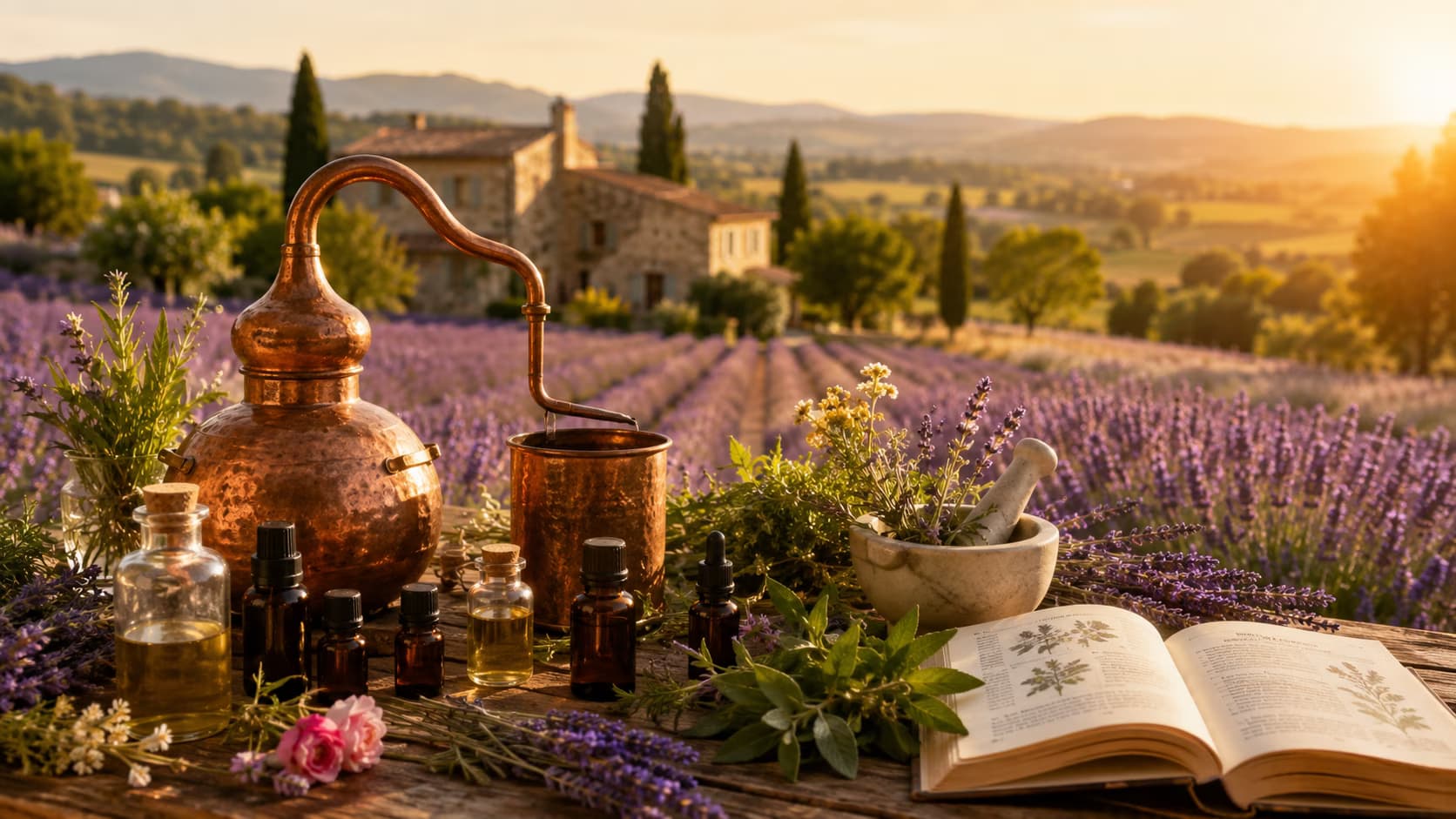
What Aromatherapy Actually Is
The National Association for Holistic Aromatherapy (NAHA) defines aromatherapy as the therapeutic use of genuine, plant-derived essential oils to support physical and psychological health. Nothing in that definition mentions a product catalog, sponsorship, or a rank to climb.
In professional practice, that means: recognized training (NAHA, the Alliance of International Aromatherapists, or equivalent), working knowledge of aromatic molecule chemistry, dilution and safety protocols, and, critically, no conflict of interest between the advice given and a personal sales target.
That last part is what most clearly separates professional practice from the MLM model, as the next section shows.
What Is an MLM?
Multi-level marketing (MLM) is a sales model where income comes from two sources: direct product sales, and a commission on the sales made by people you recruited (and the people they recruit in turn). Companies like doTERRA and Young Living use this model to distribute their essential oils.
The problem isn't the product: it's the economic structure. A 2018 AARP Foundation study surveying MLM participants (across all industries, not just essential oils) found that 74% of distributors lose money or make none; only 25% turn a profit, and more than half of those earn less than $5,000 a year.
That figure isn't specific to essential oils: it's a structural feature of the MLM model in general. But it partly explains why the pressure to recruit and sell can push some distributors toward exaggerating what the product they represent can actually do.
- Plant chemistry
- Safety and dilution protocols
- Recognized training (NAHA, AIA…)
- Individual assessment
- No fixed product catalog
- Sales of a fixed catalog
- Paid recruitment
- Multi-level commissions
- Rank advancement
- 74% of distributors lose money or make none (AARP, 2018)
Two Different Conversations
Faced with the same question, "I have joint pain, what do you recommend?", an aromatherapist and an MLM distributor don't lead the same conversation.
The aromatherapist asks:
- What treatments are you already on?
- Any allergies or skin sensitivities?
- Are you pregnant, or do you have a relevant medical condition?
- What application route is appropriate, and at what dilution?
The MLM distributor typically offers:
- The catalog's "wellness" kit
- Neat application, no dilution assessment
- A personal testimonial as proof of efficacy
- An invitation to join the sales team
Where It Actually Went Wrong
2014: FDA Warning Letters
On September 22, 2014, the FDA issued formal warning letters to doTERRA International and Young Living Essential Oils. Distributors from both companies were publicly claiming certain essential oils could prevent or treat Ebola, cancer, autism, or Alzheimer's. The FDA cited specific posts, including one from a Young Living consultant: "Viruses (including Ebola) are no match for Young Living Essential Oils." Both companies had 15 days to correct the postings.
March 2023: FTC Action Against Three doTERRA Distributors
The Federal Trade Commission sued three doTERRA distributors, Dr. Tina Wong (a pediatrician), Eliza Johnson Bacot (a nurse practitioner), and Lauren Busch (a former registered nurse), for claiming, in 2022 webinars, that certain oils worked against COVID-19. Dr. Wong stated that "oregano is effective against a coronavirus" and that "lemon and geranium essential oil inhibit the mRNA transcription of the virus." None of the three could produce clinical evidence. Each paid a $15,000 penalty and is now barred by court order from making health claims without FDA approval.
What stands out in both cases: it wasn't the companies themselves that invented these miracle claims, but individual distributors, often healthcare professionals, which made the false claims all the more credible to the public.
Independent Perspective
Receive guidance free from commercial incentives and marketing pressure.
Free first call · 15 min · no commitment
The Plants We Forget
The debate over health claims often overshadows an equally real problem: what mass demand does to the plants themselves.
A 2019 study published in Nature Sustainability by Dutch and Ethiopian ecologists modeled the future of Boswellia (the tree frankincense comes from). Conclusion: under current harvesting pressure (repeated tapping, trees exploited too young, no rest periods), global frankincense production could be cut in half within 20 years, and 90% of Boswellia populations could disappear by 2070.
This isn't a problem invented to criticize MLM: it's a mass-demand problem affecting the entire essential oil supply chain. But distribution organized around growing sales volumes and recruitment targets structurally creates more pressure on supply than small-scale artisanal sourcing does.
Responsible aromatherapy cares as much about harvest traceability as about what's in the bottle.
What an Actual Practice Looks Like
Concretely, a professional aromatherapy consultation involves: a review of medical history and current treatments, an assessment of contraindications (pregnancy, epilepsy, skin conditions, drug interactions), a choice of molecules based on their biochemical composition rather than a plant's common name, and a dilution calculation matched to the application route and the person.
None of that depends on a supplier. It's a method, not a brand.
What Aromatherapy Deserves
Aromatherapy deserves to be judged on its own merits:
- documented, verifiable plant chemistry
- safety protocols, not promises
- traceability from harvest to bottle
- a practice centered on the person, not a sales target
None of that needs a recruitment system to exist.
FAQ: Aromatherapy & MLM
Aromatherapy is a plant-based practice centered on chemistry, safety, and individualized care. An MLM (multi-level marketing) is a sales model where income depends primarily on recruiting new sellers, not just on product sales.
They are MLM companies that sell essential oils. They are not training bodies or professional aromatherapy practices: those two things are independent of the sales model.
Not necessarily. Essential oil quality depends on GC-MS testing, batch traceability, and producer transparency, not the sales channel. The actual documented problem isn't product quality, it's the health claims made by some distributors (see the FDA's 2014 warning letters and the FTC's 2023 action, detailed below).
Sometimes, yes: the molecule is the molecule. The difference is in sourcing criteria (chemistry and safety rather than a fixed catalog) and in the total absence of incentive to make unverified health claims.
Yes. In 2014, the FDA sent formal warning letters to doTERRA and Young Living over distributors claiming their oils could treat Ebola, cancer, or autism. In March 2023, the FTC sued three doTERRA distributors for falsely claiming certain oils worked against COVID-19; each paid a $15,000 penalty.
Need an independent perspective?
Between marketing claims, influencers, and commercial messaging, it can be difficult to know who to trust. A consultation provides an independent perspective focused on your actual needs.
Free first call · 15 min · no commitment
Continue reading
Sources (7 studies)▾Every study below was read in full while writing this article. Every numerical claim in the text traces back to one of them.
[1] U.S. Food and Drug Administration, 22 Sept. 2014
FDA Warning Letter to doTERRA International
[2] Federal Trade Commission
FTC Takes Action Against doTERRA Distributors for False COVID-19 Health Claims
(2023)
[6] NAHA (National Association for Holistic Aromatherapy)
Aromatherapy professional association