Aroma Chemistry
Understanding Top, Heart & Base Notes in Aromatherapy
Reviewed by Quentin Olagne, certified aromatherapist (NAHA) • May 10, 2026
You composed a blend, smelled it, perfect. Ten minutes later it was gone, as if it evaporated along with the last of your patience. Or the opposite: an hour later it's still there, heavy and one-note, when you were expecting something bright and evolving. That's not a proportion error. It's a rhythm error, and aromatic rhythm is exactly what top, heart, and base notes help you understand and control.
Why Aromatic Notes Exist
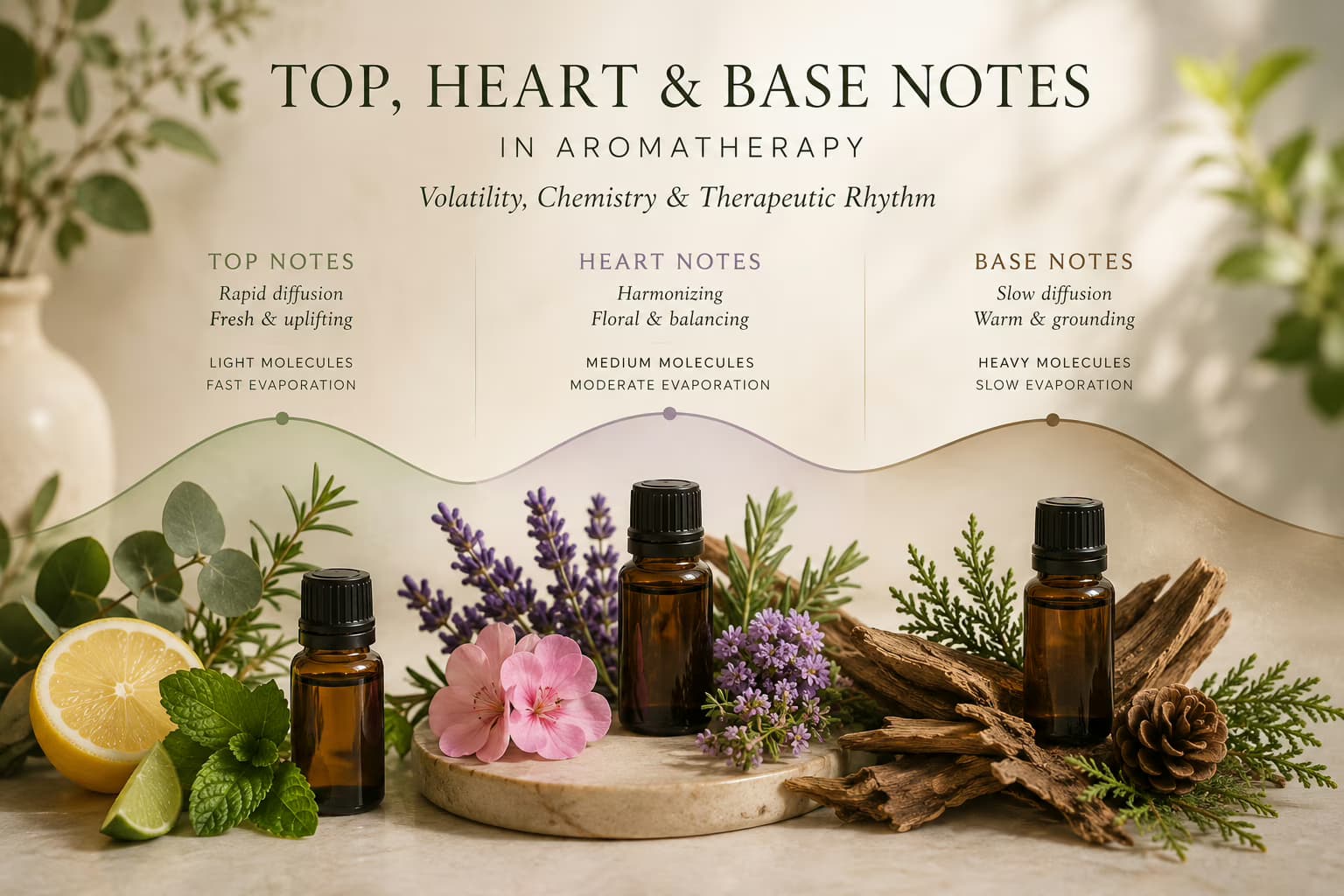
Aromatic notes describe how quickly scent molecules evaporate and become perceptible to the olfactory system. It's a physical property first, not a hierarchy of value.
Light and highly volatile molecules appear immediately and fade quickly. Heavier and less volatile molecules persist longer and create a deeper, more grounded sensation.
Monoterpenes found in many citrus oils are especially volatile, while sesquiterpenes and sesquiterpenols found in patchouli (Pogostemon cablin), vetiver (Chrysopogon zizanioides), or sandalwood (Santalum album) evaporate much more slowly.[1]
Top Notes
Top notes are the first aromas perceived when a blend is opened. They bring freshness, brightness, and immediacy: they're what makes you say "yes" or "no" within the first second.
They diffuse rapidly into the air and often create an uplifting or airy sensation. They're also the most environmentally sensitive molecules: heat, light, air, all of which degrade them faster than any others.
Top notes are dominated by monoterpenes (limonene, pinenes, myrcene) which also oxidize faster than other molecular families. High volatility and oxidation sensitivity are two sides of the same chemical coin.
Examples
- Lemon (Citrus limon)
- Grapefruit (Citrus × paradisi)
- Peppermint (Mentha × piperita)
- Eucalyptus (Eucalyptus globulus)
- Citronella (Cymbopogon nardus)
Dominant Chemistry
- Monoterpenes
- Aldehydes
- Limonène
- Pinène
- Citral
Because monoterpene-rich oils oxidize more quickly, see our guide to essential oil oxidation.
Heart Notes
Heart notes form the emotional and aromatic center of a blend. They bridge the freshness of top notes with the depth of base notes, and they're often what defines a blend's identity once the opening has faded.
They often include floral, herbal, or harmonizing oils rich in esters and monoterpene alcohols. These are generally well-tolerated, gentle molecules that carry duration without dominating.
Linalool and linalyl acetate found in true lavender (Lavandula angustifolia) beautifully illustrate this balancing dynamic, two closely related molecules that explain why lavender slots naturally into almost any blend.
Linalool from true lavender and linalyl acetate from lavandin are chemically close, but produce two distinct aromatic profiles: one more floral and soft, the other more herbaceous and camphoraceous. That chemical nuance explains why two lavenders from the same botanical family can smell so different.
Examples
- Lavender (Lavandula angustifolia)
- Geranium (Pelargonium × asperum)
- Rosemary (Salvia rosmarinus)
- Clary Sage (Salvia sclarea)
Dominant Chemistry
- Esters
- Monoterpene alcohols
- Linalool
- Linalyl acetate
Base Notes
Base notes provide depth, stability, and persistence to aromatic blends. Their slow evaporation slows the overall dissipation of the blend and creates a warmer, more enveloping and grounded sensation.
Oils rich in sesquiterpenes and sesquiterpenols often carry a calmer, woody, more meditative profile. They also act as natural fixatives: in the presence of a base note, the other components of a blend remain perceptible much longer.
Patchouli and sandalwood can continue to develop favorably for many years in the bottle: some base-note oils are literally better with age. It's one of the reasons perfumers treat them as long-term aromatic investments, not consumables.
Examples
- Patchouli (Pogostemon cablin)
- Vetiver (Chrysopogon zizanioides)
- Sandalwood (Santalum album)
- Atlas Cedarwood (Cedrus atlantica)
Dominant Chemistry
- Sesquiterpenes
- Sesquiterpenols
- Patchoulol
- Santalols
Volatility & Chemistry
Chemical Families Shape Aromatic Rhythm
Aromatic notes are directly connected to molecular volatility and the dominant aromatic families found in essential oils.[2]
This same volatility also influences how quickly molecules oxidize. Oils dominated by monoterpenes are generally less stable over time than oils rich in sesquiterpenes, which has direct consequences for the storage and shelf life of your blends.
Monoterpenes
- Highly volatile
- Fresh diffusion
- Top note behavior
- Uplifting profile
Esters & Alcohols
- Balancing
- Floral structure
- Heart note rhythm
- Relaxing qualities
Sesquiterpenes
- Grounding
- Slow evaporation
- Fixation effect
- Warm woody profile
And you, what are you naturally drawn to?
In practice, most people have a natural affinity for one of these three registers, often without knowing it. Here are three profiles I encounter regularly in consultations.
Profile 1
Freshness first
You open a bottle of lemon or peppermint and love it immediately. Your diffuser needs to smell from the first minute, otherwise you add more drops. The risk: your blends fade fast, lacking any anchor. A single heart note would change everything.
Profile 2
Balance above all
You like what stays present without dominating. Lavender, geranium, clary sage: you naturally gravitate toward heart notes. Your blends are often pleasant but sometimes a little flat: they lack the brightness of an opening or the depth of a base to really come alive.
Profile 3
Warmth and persistence
You sometimes wear oils like a perfume. Sandalwood, cedar, vetiver: you want something that lasts and grounds. Your blends hold up over time, but others sometimes find them intense. Without a top note to open the space, base notes can feel overpowering.
If you recognize yourself in one of these profiles, you already know something essential about what draws you to aromas. If you don't fit neatly into any of them, or if you sense your relationship with scent is more nuanced than three boxes, that's exactly the kind of conversation a consultation is designed to explore.
These profiles aren't labels, they're entry points into formulation. The same set of oils can yield very different blends depending on who is composing and what they're after.
Formulation
Building a Balanced Blend
Knowing your profile means knowing where to start. But formulation is also a structure: a framework that gives your oils the space to express themselves over time.[3]
Typical Structure
Top Notes
20–30 %
Heart Notes
40–60 %
Base Notes
15–30 %
Real case: Mediterranean Evening
Charlotte and Nathan both consult me for the same thing: a blend for their evening ritual, diffuser on when they get home, like an olfactory threshold between outside and inside. Same intention. Same set of oils. Very different results.
Charlotte
Bergamot (Citrus bergamia) · Lemon
Lavender · Geranium
Atlas Cedarwood
She needs to smell the blend from the first second. The opening must exist, that's why the patchouli is almost gone.
Nathan
Lemon (light touch)
Geranium · Lavender
Atlas Cedarwood · Patchouli
He wants the blend to stay after he leaves the room. Atlas cedarwood (woody, grounding, with the resonance Western perfumery calls "masculine") is the anchor here.
But that's not the end of the story. Take two other people with the same profile as Charlotte: one will lean all the way into bergamot, rounder, floral, soft. The other will prefer lemon, brighter, sharper, almost electric. Same basket. Same Profile 1. Two different blends. And that's exactly where the complexity, and the value, of truly personalised formulation lives.
These accords (bergamot, lavender, cedarwood) are known, tested, and they work. But calibrating them precisely for a person, a moment, an intention: that's skilled work. It's exactly what an aromatic consultation is designed to accomplish.
The most common mistake
A blend made entirely of top notes smells wonderful for the first few minutes, then disappears like a promise that wasn't kept. Conversely, a blend dominated by base notes can quickly feel suffocating and impossible to lift. The ratio isn't an arbitrary rule: it's the olfactory translation of a timeline. An opening, a development, a resolution.
Aromatic notes remind us that an essential oil is never a static scent. Each essence evolves through time, moves through space differently, and interacts with perception in a way that is both chemical and deeply personal.
Knowing where you stand within these three registers, and understanding which oils resonate with you in each, is the first real step toward a formulation that actually feels like you. Not a calculation. A conversation between you, your senses, and the plants you choose.
Formulation
A blend that fades too fast or sits too heavy? Let's look at it together.
Free first call · 15 min · no commitment
FAQ
It's probably dominated by top notes, highly volatile monoterpenes like limonene. Adding a heart note (lavender, geranium) or a base note (cedar, patchouli) creates anchoring that extends how long the blend stays perceptible.
No. Volatility isn't a measure of therapeutic worth. Menthol from peppermint (a top note) is one of the most well-studied aromatic compounds. What base notes provide is persistence, not necessarily greater efficacy.
Yes, and it's often a good starting point. An all-heart-note blend will be balanced and persistent, but it will lack the bright opening of a top note and the grounding depth of a base note.
The simplest test: in a shop, which shelf draws you instinctively? Citrus and mint (top notes), florals and herbals (heart notes), woods and resins (base notes). That first instinctive pull, before you even open a bottle, usually says a lot. An aromatic consultation is designed to refine that intuition and give it a concrete direction.
These categories don't exist in aromatic chemistry. They're cultural conventions, not molecular properties. Cedar, vetiver, myrrh are perceived as 'masculine' in the contemporary Western context: that's the result of decades of marketing, not biochemistry. In personalised formulation, only individual affinities matter.
Build more balanced blends
Understanding top, heart and base notes is only the first step. A consultation can help you build blends adapted to your goals, experience and available oils.
Free first call · 15 min · no commitment
Scientific References▾Every study below was read in full while writing this article. Every numerical claim in the text traces back to one of them.
[1] Analyst, 148, 6228–6240
Analysis of the volatile monoterpene composition of citrus essential oils by photoelectron spectroscopy
Ganjitabar, H., Hadidi, R., Garcia, G.A., Nahon, L., & Powis, I. (2023)
[2] Talanta
An innovative device for in vivo and in vitro study of fragrance evaporation after application on skin or model surfaces
Hadjiefstathiou, E., Terescenco, D., Loisel, A., Picard, C., Malhiac, C., & Savary, G. (2024)
[3] Digital Chemical Engineering, 15, 100223
Revolutionizing perfume creation: PTD's innovative approach
Iqbal, A., Bhat, M.A., Muneeb, Q., & Javid, M. (2025)
Continue reading