Sources
Terre d'Alchimie
Behind every distillate lies a landscape, a season, and a human gesture.
We seek out independent distillers whose philosophy aligns with ours: respect for plants, slow extraction, aromatic integrity, and living terroir.
Auvergne, France
A distillery rooted in slowness, land, and aromatic precision.
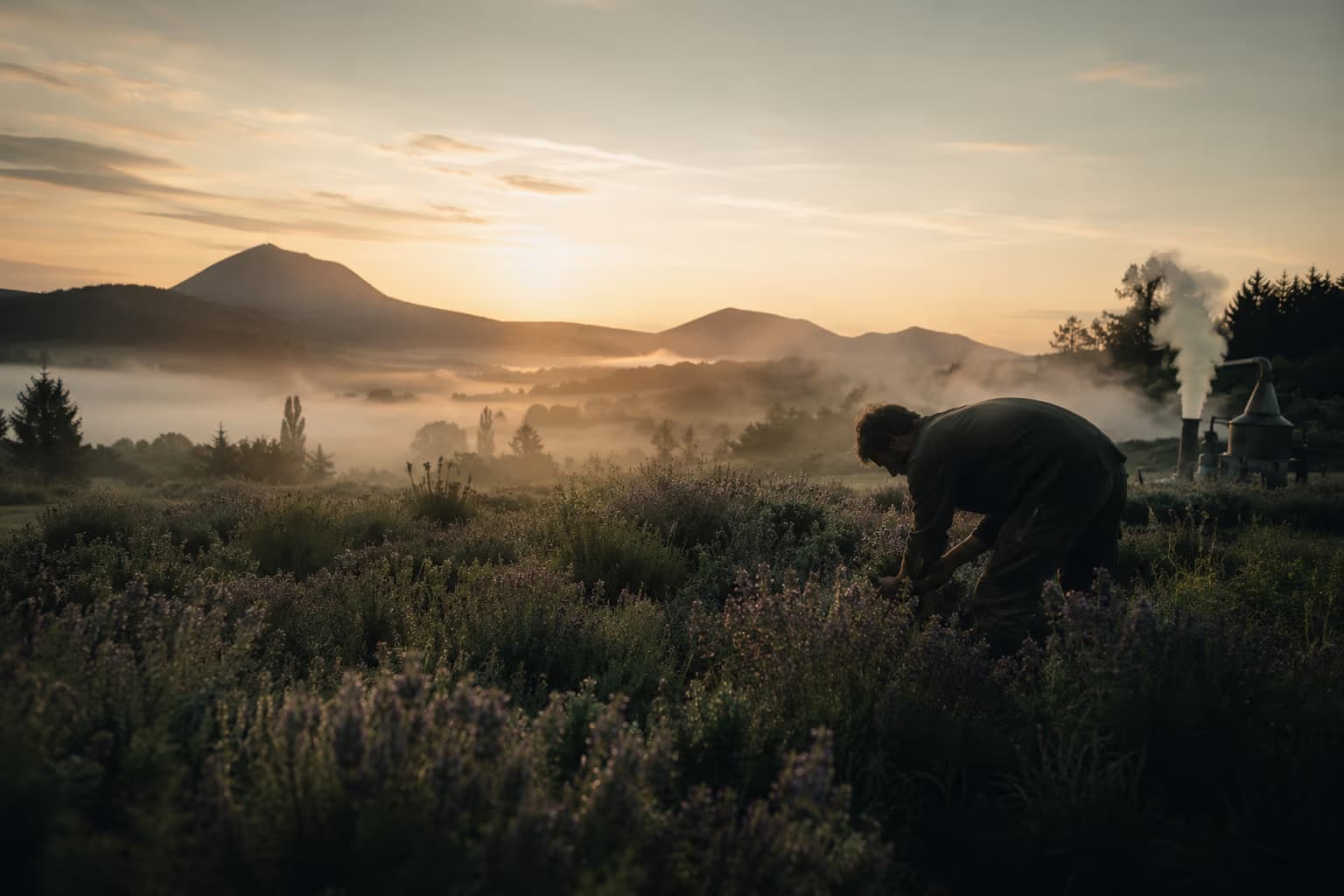
Nestled in the volcanic landscapes of Auvergne, Terre d'Alchimie cultivates and distills aromatic and medicinal plants with a deeply artisanal approach.
Founded by Florent Chauvin in 2018, the distillery continues a philosophy centered around respect for the plant, manual harvests, low-pressure distillation, and the preservation of aromatic integrity.
What immediately resonated with us was the coherence between the land, the cultivation methods, and the gesture of distillation. Nothing feels industrial. Everything feels observed, intentional, and alive.
Distiller Profile
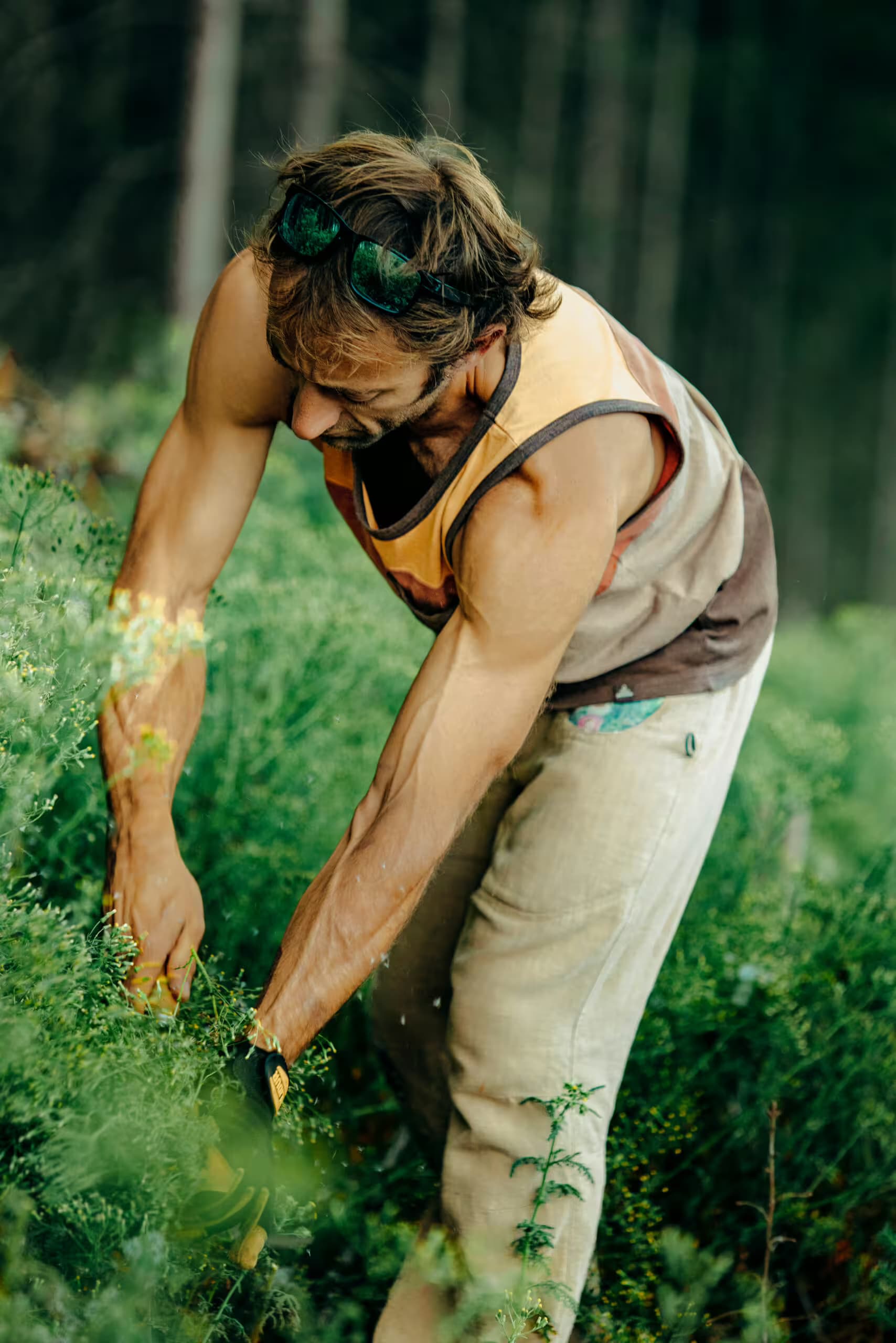
Florent Chauvin
Cultivation, harvest and distillation stay in the same hands, on a rhythm set by the seasons rather than by yield.
Production & practices
Human-scale agricultural production.
The distillery cultivates aromatic and medicinal plants at small scale, through crop rotation and biodiversity preservation practices.
Harvesting is entirely manual and carried out at optimal plant maturity.
Distillation is carried out on-site, with spring water, in a stainless steel still run at low pressure.
Each batch is produced in limited quantities according to seasonal harvesting and distillation capacity.
Distillation Philosophy
Distillation is not simply extraction.
Terre d'Alchimie works with a stainless steel still run through gentle low-pressure distillation, using spring water.
The goal is not maximal yield, but aromatic fidelity — preserving the volatile, delicate, and living character of the plant.
Harvests are done manually and follow the rhythm of the seasons. Soil work remains minimal and biodiversity is preserved through crop rotation and careful cultivation.
This slower approach creates oils and hydrolats that feel deeply connected to place, climate, altitude, and seasonality.
Why Terre d'Alchimie
“A readable, grounded distillation without rupture between plant and expression.”
What makes Terre d’Alchimie relevant in our selection is the absence of separation between cultivation, transformation, and final product.
The result is a legible production where each oil clearly reflects its terroir and transformation cycle.
This approach directly reflects our selection method: prioritizing readable systems over fragmented supply chains.
Why this source
Direct producer in Auvergne with full control of the cycle, from cultivation to distillation.
Ecological sourcing
Low-intervention cultivation
Organic farming, biodynamics, diversified and manual systems.
Aromatic transformation
Integrated artisanal distillation
Own still, full process control, low pressure distillation.
Producer relationship
Direct producer relationship
Fully controlled chain from producer to product.
How we evaluate our sources
Each source is evaluated along three axes: the ecological origin of the plant, the integrity of the transformation process, and the nature of our relationship with the producer. This grid doesn't replace our judgment — it makes it checkable.
Aromatic Terroir
An essential oil is never just a molecule.
It is a climate, a soil, an altitude, and a season.
Understanding What You’ve Just Seen
What terroir and distillation reveal… and chemistry explains
What you’ve just seen in Terre d’Alchimie is not only artisanal work : it is a direct expression of chemical and aromatic phenomena explored in depth in the following articles.
Aromatic Stability
Why an oil changes after distillation
Understand how oxygen, light, and time transform oils produced through artisanal distillation like Terre d’Alchimie.
Aromatic Perception
Why an oil is never smelled as a single layer
Explore how top, heart, and base notes structure the olfactory experience of terroir-driven oils.
Professional Sourcing
Is this the right producer for your need?
Finding Terre d'Alchimie is only the first step. Knowing whether their oil, chemotype and production capacity actually fit your project is another matter, that's the work I do with the brands, formulators and practitioners who reach out to me.