Carrier Oils
Carrier Oils Guide: Jojoba, Coconut, Rosehip & How to Choose
Reviewed by Quentin Olagne, certified aromatherapist (NAHA) • July 1, 2026
In aromatherapy, essential oils often get all the attention. Yet in almost every blend I formulate, it's the carrier oil doing the real work (hydrating, nourishing, soothing) while the essential oil simply enriches the whole.
Comparing the properties of jojoba, coconut, and rosehip oil helps select the most suitable carrier oil for your skin type and intended use, and as you'll see, two people with the exact same intention can walk away with two very different formulations.
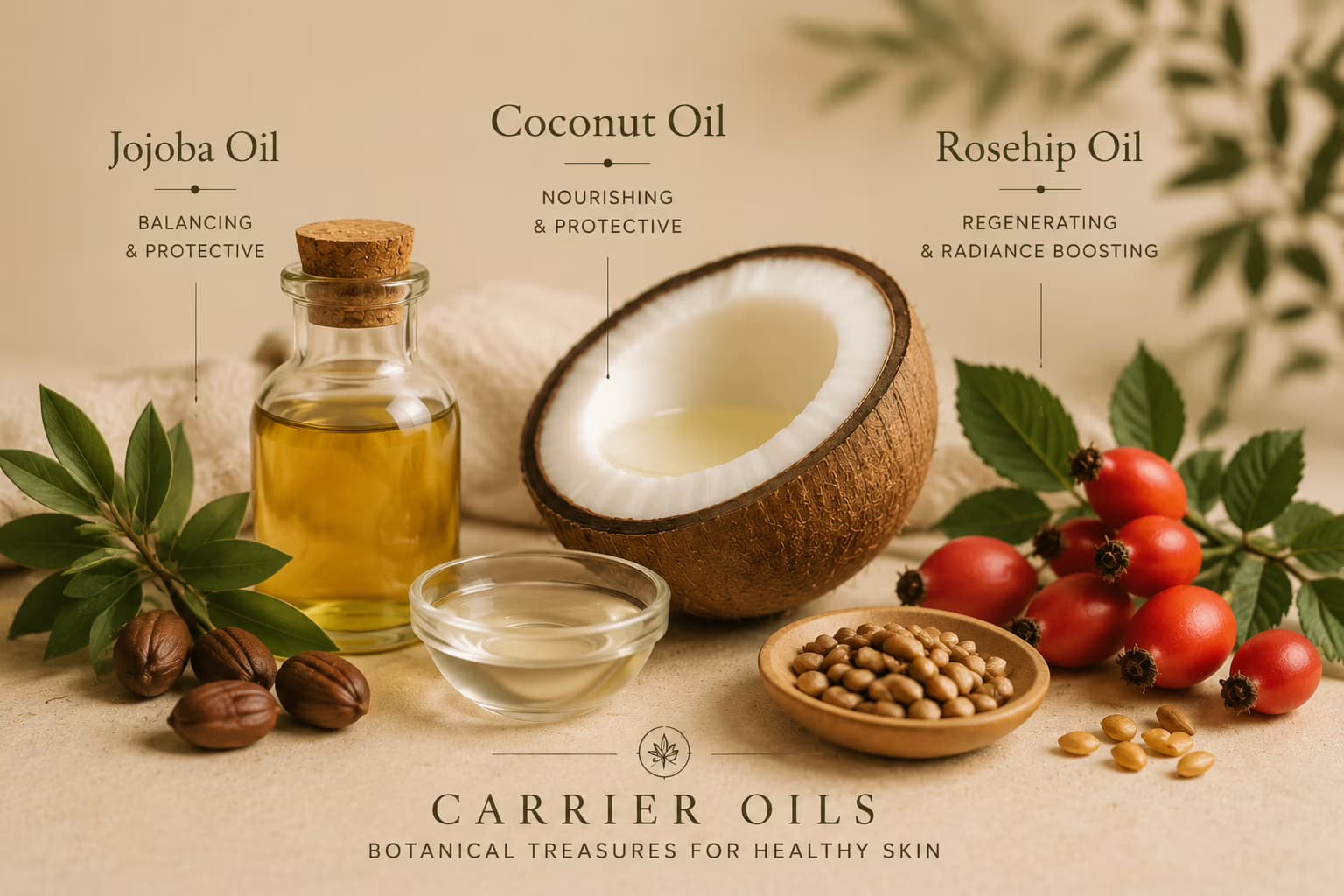
Why Use a Carrier Oil?
Carrier oils play several essential roles:
- Dilute essential oils for safer application.
- Nourish and protect the skin barrier.
- Facilitate massage and improve glide.
- Provide fatty acids, vitamins, and antioxidants naturally present in plants.
Carrier oils are generally obtained by mechanical pressing of seeds, nuts, or fruits. The most sought-after quality is usually a virgin, cold-pressed oil.
Quick Comparison
Each carrier oil has a unique profile. This table provides a quick overview of the key differences between jojoba, coconut, and rosehip oil.
| Oil | Texture | Absorption | Stability | Best For |
|---|---|---|---|---|
| Jojoba | Light | Fast | Excellent | Oily, combination and sensitive skin |
| Coconut | Rich | Moderate | Excellent | Dry skin, hair and body care |
| Rosehip | Light | Fast | Moderate | Mature skin and facial care |
Jojoba Oil
Composed mainly of wax esters rather than triglycerides, jojoba oil exhibits remarkable oxidative stability and a composition similar to human sebum. Jojoba oil (Simmondsia chinensis) is extracted from the seeds of the plant and has excellent skin affinity.
Did you know? Jojoba oil is technically not an oil but a liquid wax composed of nearly 98% wax esters. This unique structure explains its remarkable stability and excellent skin affinity.
- Dry touch
- Highly oxidation-stable
- Suited for combination to oily skin
- Compatible with scalp treatments
Coconut Oil
Coconut oil is obtained from coconut flesh. Rich in saturated fatty acids, particularly lauric acid, it offers a rich and protective texture highly valued in body and hair care.
- Highly nourishing
- Good oxidative stability
- Ideal for body and hair care
- May be too rich for some oily skin types
Rosehip Oil (Rosa canina)
Rich in polyunsaturated fatty acids, phenolic compounds, and natural antioxidants, rosehip oil (Rosa canina) is especially valued for facial care and mature skin. Scientific literature highlights its richness in polyphenols, flavonoids, and vitamins that contribute to its antioxidant and skin-protective properties.
Did you know? Rosehip (Rosa canina) naturally contains polyphenols, carotenoids, vitamins, and essential fatty acids. The seeds used to produce the oil are particularly rich in linoleic and α-linolenic acids.
- Light texture
- Highly valued in facial care
- Suitable for mature skin
- More sensitive to oxidation
Choosing by Skin Type
Choosing a carrier oil mainly depends on two factors: skin compatibility and intended function (balancing, nourishing, or protecting). Jojoba stands out because it adapts to almost all skin types; its composition, close to human sebum, explains why this isn't a default recommendation but a genuine biochemical compatibility.
- Oily or combination skin: jojoba, which regulates sebum without clogging pores.
- Dry skin: coconut for richness, jojoba for balance, often both, alternating by season.
- Mature skin: rosehip for regeneration, paired with jojoba for stability.
- Sensitive skin: jojoba, which carries a very low irritation potential.
- Face: rosehip for anti-aging care, jojoba for sebum balance.
- Hair and scalp: coconut and jojoba are both excellent choices.
In practice: jojoba is lighter, non-greasy, and suited to the face as well as blemish-prone skin; coconut oil is richer but can be comedogenic on some faces, so it's better reserved for body and hair; rosehip oil is the most biologically active, but also the most fragile to oxidation, which is why it's almost always used in small amounts, layered on top of a more stable oil.
Same need, two formulations: after-sun care
Léa and Antoine both come to me the same summer for the same thing: an after-sun oil, applied in the evening shower once the salt and sand are rinsed off. Same intention, same beach day, but their skin has different needs, and the formulation changes completely.
Léa
Base: coconut oil, applied generously
Active: true lavender, a few drops
Her skin feels tight after sun and salt: she needs richness, not lightness. Coconut repairs the lipid barrier; lavender calms without adding more heaviness.
Antoine
Base: jojoba oil, applied lightly
Active: geranium, a few drops
The same coconut oil would leave him shiny and uncomfortable by bedtime. Jojoba repairs without clogging; geranium soothes while helping rebalance sebum stressed by the heat.
Lavender and geranium play a precise role here: they're heart notes, as explained in our article on top, heart, and base notes, they provide the persistence and balance an after-sun gesture needs: not a bright opening that fades in ten minutes, but something that lingers and soothes while the skin repairs itself.
This is exactly the principle explored in our lavender article: the same intention (soothe, repair) doesn't automatically lead to the same oil for everyone. Understanding the plant isn't enough; you also need to understand the person in front of you.
One safety detail worth noting: on skin that just had sun exposure, expressed citrus oils (lemon, non-FCF bergamot) are best avoided due to their phototoxicity risk. Lavender and geranium carry no such constraint.
"A few drops" depends on your bottle size. To turn that into a precise percentage, our formulation tool does the math.
Botanical Perspective
Carrier oils are often misunderstood as simple dilution bases for essential oils. In reality, they form the structural and biochemical foundation of most topical aromatherapy and natural skincare applications.
Rich in essential fatty acids, phytosterols, antioxidants, and lipid compounds, they interact directly with the skin barrier. In many formulations, their long-term impact on skin health and resilience is often greater than that of essential oils, which are used at very low concentrations.
In this context, essential oils act as targeted aromatic concentrates that can enhance a formulation, but they are not the primary vehicle for nourishment, repair, or barrier support.
The choice of carrier oil therefore becomes a central decision in any skincare formulation. A well-matched oil can support lipid barrier repair, improve elasticity, reduce transepidermal water loss, and contribute to healthier, more resilient skin over time.
Beyond jojoba, coconut, and rosehip oils, many other carrier oils offer distinct functional properties: tamanu oil for its traditional use in skin regeneration, sunflower oil for its high linoleic acid content and barrier compatibility, and argan oil for its antioxidant richness.
This guide focuses on three foundational oils for clarity, but the broader world of botanical lipids is far more extensive. It continues to be studied for its dermatological, cosmetic, and functional relevance.
Carrier Oils
Find the carrier oil best suited to your situation.
Free first call · 15 min · no commitment
Storage, Oxidation & Shelf Life
| Oil | Shelf life (after opening) |
|---|---|
| Jojoba | 2–3 years |
| Coconut | 1–2 years |
| Rosehip | 6–12 months |
Carrier oils evolve after opening. Their stability depends not only on composition, but also on exposure to air, light, and heat.
Oxidation accelerates after opening due to oxygen exposure and repeated contamination.
Signs of degradation: rancid or metallic smell, color change, thicker or sticky texture.
Storage hierarchy
- Level 1: Room temperature (stable oils like jojoba)
- Level 2: Refrigeration (rosehip, fragile oils)
- Level 3: Balm conversion (solid-state preservation)
- Optimal storage: cool, dark, and stable environment (15–20°C)
- Reduce oxygen exposure: close immediately and minimize open containers
- Split large bottles to reduce repeated air exposure cycles
- Natural antioxidants: vitamin E or rosemary extract
- Refrigeration useful for fragile oils (rosehip, evening primrose)
Solid-state preservation (balms & anhydrous systems)
To extend stability, some oils can be incorporated into solid matrices (balms using waxes or plant butters), significantly reducing air exposure and slowing oxidation.
Solid formulations are especially effective for fragile oils and allow better preservation without synthetic additives.
Frequently Asked Questions
Jojoba is often regarded as the ideal carrier oil due to its oxidative stability, light texture, and compatibility with all skin types. However, the best choice also depends on your preferences and intended use: coconut for body, rosehip for face, etc.
Jojoba and rosehip oils are known for their fast absorption and non-greasy feel, making them ideal for facial care and oily or combination skin.
Yes, you can and are even encouraged to blend different carrier oils to benefit from their complementary properties. For example, combine the stability of jojoba with the richness of rosehip.
Jojoba is very well tolerated by sensitive skin due to its composition similar to human sebum and its low allergenic potential.
Rosehip oil is highly regarded for its regenerating properties and anti-aging effects. Jojoba, meanwhile, suits all skin types and helps balance sebum production.
It mainly depends on your skin type: coconut for dry skin that needs richness, jojoba for oily or combination skin that needs lightness. In both cases, avoid expressed citrus essential oils (phototoxic) in favor of lavender or geranium.
Which carrier oil should you choose?
The right carrier oil depends on your skin, goals and essential oils. A consultation can help narrow down the best options.
Free first call · 15 min · no commitment
Sources & Further Reading▾Every study below was read in full while writing this article. Every numerical claim in the text traces back to one of them.
[1] Churchill Livingstone / Elsevier, 2nd edition
Essential Oil Safety: A Guide for Health Care Professionals
Tisserand, R., & Young, R. (2014)
[2] New World Library, 25th anniversary edition
The Complete Book of Essential Oils and Aromatherapy
Worwood, V.A. (2016)
[3] Healing Arts Press
Advanced Aromatherapy: The Science of Essential Oil Therapy
Schnaubelt, K. (1998)
[4] Polymers
Jojoba Oil: An Updated Comprehensive Review on Chemistry, Pharmaceutical Uses, and Toxicity
Habashy, R.R. et al. (2021)
[5] PMC
Recent Advances and Insights into the Bioactive Properties and Applications of Rosa canina L. and Its By-Products
Negrean, O.-R. et al. (2024)
Continue reading